
Why I Have Sent The Home Office A Freedom Of Information Request Over Its Asylum Seekers Photography Leaflet
A few days ago I became aware of a leaflet published by the Home Office concerning photography and filming in the UK.
The leaflet, titled “Photography and filming: support for asylum seekers”, was published on the Government website on 19 August 2026. It forms part of a collection of material intended to explain behaviour and expectations to people seeking asylum in the UK.
There is nothing particularly controversial about providing people arriving in this country with clear information about British laws and customs.
The problem is that some of the information in this particular leaflet appears not to accurately describe British law.
The poster says:
“Do not photograph or film people in public.”
It specifically says this includes public spaces such as streets and parks.
It then warns:
“If you do these things, you could be arrested by the police.”
The accompanying page on GOV.UK goes even further, describing the poster as explaining that you cannot take pictures or videos of someone without their permission in the UK.
There is an obvious problem with this.
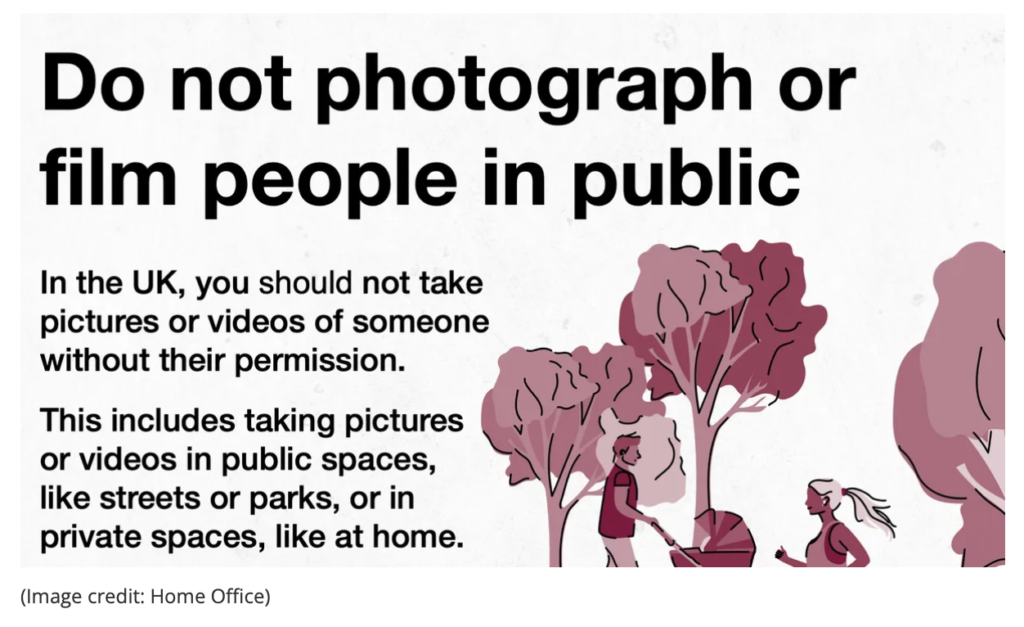
Photography Advice For Asylum Seekers Home Office Leaflet
That Isn’t The General Law On Photography In Britain
There is no general law in the UK requiring a photographer to obtain somebody’s permission simply because that person appears in a photograph taken in a public place.
There are, of course, important exceptions.
Photography can form part of harassment or stalking. There are laws dealing with voyeurism and intimate images. There are circumstances in which someone can have a reasonable expectation of privacy, even though the photographer may be standing somewhere public. There are also questions surrounding data protection and the subsequent use of photographs.
But none of those things creates a general rule saying:
You cannot photograph another person in a street or park without first obtaining their permission.
In fact, the Metropolitan Police’s own published photography guidance says:
“Members of the public and the media do not need a permit to film or photograph in public places.”
The Met goes on to state that police have no general power to stop people filming or photographing incidents or police personnel.
Historic national police guidance has been similarly clear. Guidance published by what was then the Association of Chief Police Officers stated that there were no powers prohibiting the taking of photographs, film or digital images in a public place and that members of the public and press should not be prevented from doing so.
That is rather difficult to reconcile with a Home Office poster telling people not to photograph anyone in streets or parks and warning that doing so could result in arrest.
The National Union Of Journalists Has Challenged It
I am certainly not the only person who has noticed the problem.
On 25 August, the National Union of Journalists publicly called on the Home Office to correct the material.
The NUJ described the leaflet as making a “misleading blanket claim” and said that the statements misrepresent the law.
The union made the important distinction that taking photographs or videos of people in public without their permission is not inherently unlawful, while recognising that particular behaviour such as harassment, voyeurism and other specific circumstances can be illegal.
The NUJ is also concerned about the consequences for photographers and videographers.
Photographers already regularly encounter people who genuinely believe that it is illegal to photograph them without permission. The NUJ says inaccurate official information could increase hostility towards photographers, lead to wrongful accusations of criminality and interfere with legitimate journalism.
As someone who has spent many years photographing ordinary life in public places, I think that is a very legitimate concern.
The Royal Photographic Society Has Now Responded Too
On 26 August, the Royal Photographic Society issued its own statement.
Its position could hardly be clearer:
“There is no general requirement in the UK to obtain permission before photographing people in a public place.”
The RPS says that the Home Office material risks creating confusion and has supported calls for it to be reviewed so that it accurately reflects the law.
Importantly, the RPS also makes the sensible point that freedom to photograph comes with responsibilities.
Something being lawful does not automatically mean that every photograph is appropriate. Photographers should consider people’s dignity, vulnerability, reasonable expectations of privacy and the circumstances in which an image is eventually used.
I agree entirely.
But “photographers should behave responsibly” is very different from “you cannot photograph somebody in public without permission.”
The first is sensible advice.
The second appears to be an inaccurate statement of the law.
Why Does This Matter?
This might sound like an obscure argument of interest only to photographers.
I don’t think it is.
Photography plays a huge part in documenting British life.
Think of almost any photograph showing a busy town centre, a political protest, a football crowd, a seaside resort, a festival, a Royal event, a news story or simply everyday life on the streets.
Those photographs could not realistically exist if every identifiable person first had to provide permission.
Street photography, documentary photography, photojournalism and a considerable amount of television news gathering would become practically impossible.
There is also an important historical element.
The photographs being taken on Britain’s streets today will eventually become the historical photographs people look at in fifty or a hundred years’ time.
Photography documents society.
That freedom obviously has boundaries, but a blanket requirement for consent in public places is not currently one of them.
So How Did This Get Through The Home Office?
That is the question that particularly interests me.
This isn’t something posted by an anonymous Facebook account.
It is official material published on GOV.UK by UK Visas and Immigration, part of the Home Office, specifically intended to educate people about behaviour and expectations in Britain.
If a government department is going to tell people that an activity could result in their arrest, I think it is reasonable to expect that somebody has checked that the activity is actually against the law.
Perhaps there is an explanation.
Perhaps legal advice was taken which we have not yet seen.
Perhaps the original intention was simply to encourage people to respect others and somewhere during the process that sensible advice became an inaccurate blanket statement.
Rather than speculate, I have decided to ask.
I Have Submitted A Freedom Of Information Request
I have now submitted a Freedom of Information request to the Home Office asking for the recorded information behind the leaflet.
Among other things, I have asked for:
- Any legal advice or legal review relating to the claim that permission is required before photographing or filming another person.
- The legislation, case law, official guidance or other legal authority relied upon when the statement was written.
- Details of which teams or departments were responsible for checking its legal accuracy.
- Records showing how the leaflet was approved and signed off before publication.
- Any concerns or proposed amendments raised internally before it was published.
- Any internal correspondence since publication discussing whether the leaflet is accurate and whether it should now be amended, withdrawn or replaced.
I’m not asking the Home Office to invent an explanation after the event.
I’m asking to see the recorded evidence showing how this statement came to be published in the first place.
There is an interesting question at the heart of it.
If the Home Office obtained legal advice supporting the statement, what was that advice and what law did it rely upon?
And if there was no recorded legal advice or legal authority, how did an official government publication warning people that they could be arrested make it through the approval process?
This Isn’t About Asylum Seekers
I think this point is particularly important.
My criticism isn’t directed at asylum seekers receiving the leaflet.
Quite the opposite.
If the Government is giving people information intended to help them understand British law, they deserve to be given accurate information.
Someone newly arrived in Britain should not be led to believe that perfectly ordinary behaviour is criminal if it isn’t.
And photographers, journalists, tourists and members of the public should not have to deal with additional confrontation because an official government publication has reinforced a misconception about photography that already exists.
The law has plenty of safeguards against genuinely intrusive, threatening or harassing behaviour.
Those safeguards should be explained properly.
But they shouldn’t be replaced with a simple blanket statement which, according to the NUJ and Royal Photographic Society, does not accurately reflect the law.
I will publish the Home Office’s response to my Freedom of Information request when it arrives.
It should be interesting to discover exactly how this happened.