
The Whitby Regatta Greasy Pole: An Evidence Based History
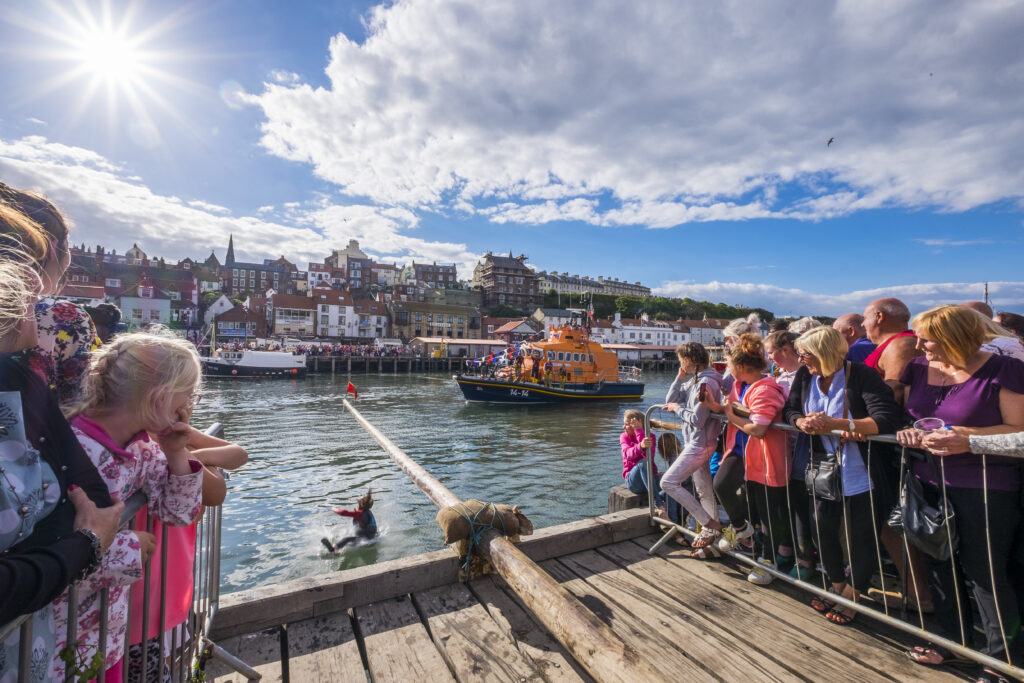
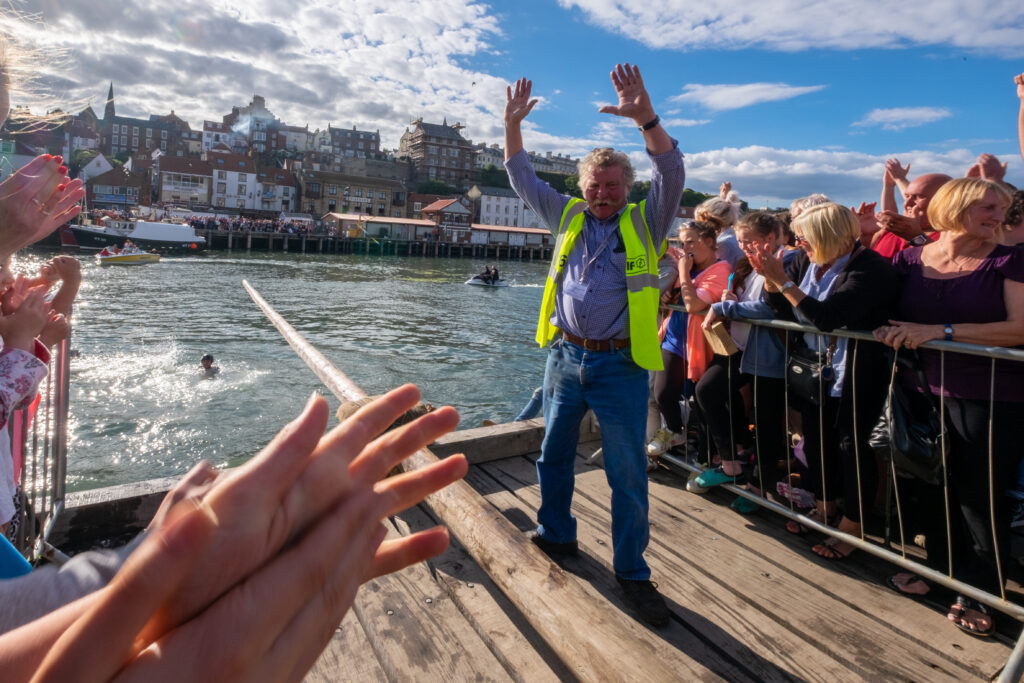
Few events at Whitby Regatta capture the imagination quite like the Greasy Pole. Year after year, competitors step onto a heavily greased wooden pole projecting over the harbour, hoping to reach the far end and claim the flag. Most end up in the water, much to the delight of the thousands of spectators lining the harbour walls.
Whitby Regatta Greasy Pole
Despite its popularity, surprisingly little has been written about the history of the Greasy Pole itself. Over the years a number of colourful stories have appeared online, linking the event to Whitby’s whaling industry or claiming it developed as training for sailors working high in the Arctic rigging of whaling ships. While these stories are certainly appealing, no reliable historical evidence has yet been found to support them.
Instead, the documented history tells a slightly different, but equally fascinating, story.
Part of a Much Older Tradition
Whitby Regatta itself has a history stretching back more than 180 years. According to the official history published by the Regatta Committee, the event grew from friendly competitions between local fishermen racing their fishing smacks and salmon cobles before developing into one of the country’s best known sea regattas.
By the late nineteenth century, yacht racing and rowing had become major attractions, with rowing clubs from across the region competing for prestigious trophies such as the Wilson Cup, first presented in 1901.
Exactly when the Greasy Pole became part of the Regatta remains unknown. None of the readily available historical sources identifies the first year in which the competition was held. However, surviving evidence shows that it has been part of Whitby Regatta for many decades.
One of Whitby’s Great Characters
One of the earliest well documented competitors is William “Billa” Usher.
Family records describe Billa as entering the Greasy Pole every Regatta. A surviving photograph, believed to date from around the late 1940s or early 1950s, shows him taking part while already in his sixties. Whether he regularly reached the flag is unknown, but the photograph captures something far more important. It demonstrates that the Greasy Pole was already a well established annual tradition enjoyed by generations of local people.
A Champion from 1979
One of the most significant discoveries during this research came from a contemporary newspaper report published in August 1979.
The article records that Harry Morrison, a 35 year old steel fixer, won the Greasy Pole competition and was presented with the Greasy Pole Cup.
This is currently the earliest confirmed newspaper report naming a winner that has been identified during this research. It also confirms that the competition had its own dedicated trophy, showing that the event occupied an established place within the wider Regatta programme.
Whether earlier winners can be identified will depend upon further examination of historic Whitby Gazette editions and surviving Regatta programmes.
The Competition
Although the basic idea appears wonderfully simple, successfully reaching the end of the pole is anything but.
A long wooden pole projects horizontally out over Whitby Harbour. The timber is heavily coated in grease before a flag is attached to the outer end. Competitors attempt to make their way along the increasingly unstable pole before removing the flag.
Modern photographs reveal another challenge that is not always obvious from the shore. The pole is not completely rigid. As competitors move forward it bends and flexes beneath their weight, making balance even more difficult.
Many competitors adopt completely different techniques. Some walk upright, others crouch low, while a few attempt to use speed and momentum before inevitably disappearing into the harbour.
Adam Steele’s Victory
One of the best documented modern competitions took place in 2016.
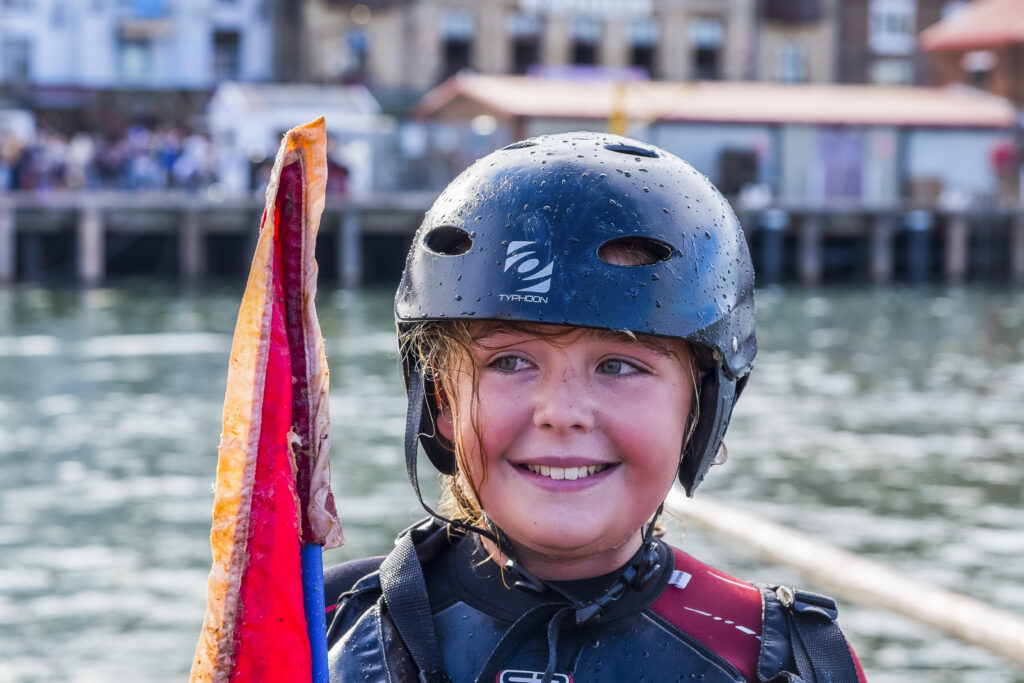
Contemporary reports record local competitor Adam Steele successfully claiming victory after needing three attempts to retrieve the flag. The report illustrates just how demanding the event can be, even for the eventual winner.
Whitby Regatta – Greasy Pole
Modern Safety
While the competition retains its traditional appearance, modern photographs show that safety arrangements have evolved considerably.
Competitors now wear protective helmets and buoyancy aids, while safety boats remain close by throughout the competition. These precautions allow the event to continue while reducing the obvious risks of falling into the harbour.
Fish Pier and Tate Hill Pier
The Greasy Pole has not always been staged from exactly the same location.
Historic photographs and programmes place the competition at Fish Pier during some years, while more recent events have been held from Tate Hill Pier. Changes appear to have reflected practical considerations within the harbour rather than any permanent relocation.
Interruptions
Like many long established traditions, the Greasy Pole has not been held every year.
Evidence shows that the event disappeared for a period after the original pole broke during the mid 2000s before eventually returning with a replacement.
More recently, the COVID pandemic disrupted Whitby Regatta, while subsequent harbour works and pier safety issues also prevented the competition from taking place in some years.
Separating Fact from Folklore
One of the aims of this research was to distinguish documented history from repeated folklore.
Several popular claims frequently appear online, including suggestions that the Greasy Pole originated as training for Whitby’s Arctic whalers, that it was introduced through Whitby’s links with Stromness in Orkney, or that Victorian winners traditionally received prizes such as legs of mutton or cured hams.
At present, no reliable historical evidence has been found to support any of these claims.
That does not necessarily mean they are impossible. It simply means they should not be presented as established history without documentary evidence.
Whitby Regatta – Greasy Pole
The Story Continues
Perhaps the most intriguing discovery is not what we know, but what we still do not know.
Whitby Museum holds Regatta programmes dating back to the nineteenth century, while historic editions of the Whitby Gazette almost certainly contain further reports, results and photographs waiting to be rediscovered. Somewhere within those archives may lie the first recorded Greasy Pole competition, forgotten champions and stories that have not been told for generations.
Until those records are examined in detail, the exact origins of Whitby’s famous Greasy Pole remain one of the Regatta’s most enjoyable historical mysteries.
What can be said with confidence is that for generations the competition has combined courage, balance, determination and good humour in equal measure. Whether competitors triumphantly remove the flag or plunge spectacularly into the harbour, the Greasy Pole continues to provide one of Whitby Regatta’s most entertaining and enduring traditions.